2D Game of Life
Conway's original Game of Life on a flat board, with the classic patterns, any life-like rule, patterns pasted as RLE, and one thing a flat player cannot show: a time stack that turns a pattern's history into a 3D sculpture. Free, in your browser.
Open the 2D Game of Life → The glider gun as a time stack →
Conway's game
John Conway's Game of Life appeared in Martin Gardner's Mathematical Games column in 1970. It is played on a grid of square cells, each alive or dead. Every generation, all cells update at once, and each looks only at its eight neighbours:
- Birth. A dead cell with exactly 3 live neighbours comes alive.
- Survival. A live cell with 2 or 3 live neighbours stays alive.
- Otherwise the cell dies, or stays dead.
That is written B3/S23: born on 3, survives on 2 or 3. From these three lines come still lifes that never change,
oscillators that repeat, gliders that travel across the board, and guns that fire gliders forever.
From 2D to 3D has a board you can draw on right in the page, and shows what happens to the rule in three
dimensions.
The time stack
A flat board shows one generation at a time. The time stack keeps the past ones too: each generation is laid under the one after it, so time becomes the third axis, and a pattern's whole history is one shape you can turn around.
- A glider moves one cell diagonally every 4 generations, so its history is a staircase.
- An oscillator repeats, so it is a column that repeats its pattern every period: a braided column.
- A still life never changes: a straight pillar.
- A gun is a set of pillars with a row of parallel staircases leaving it.
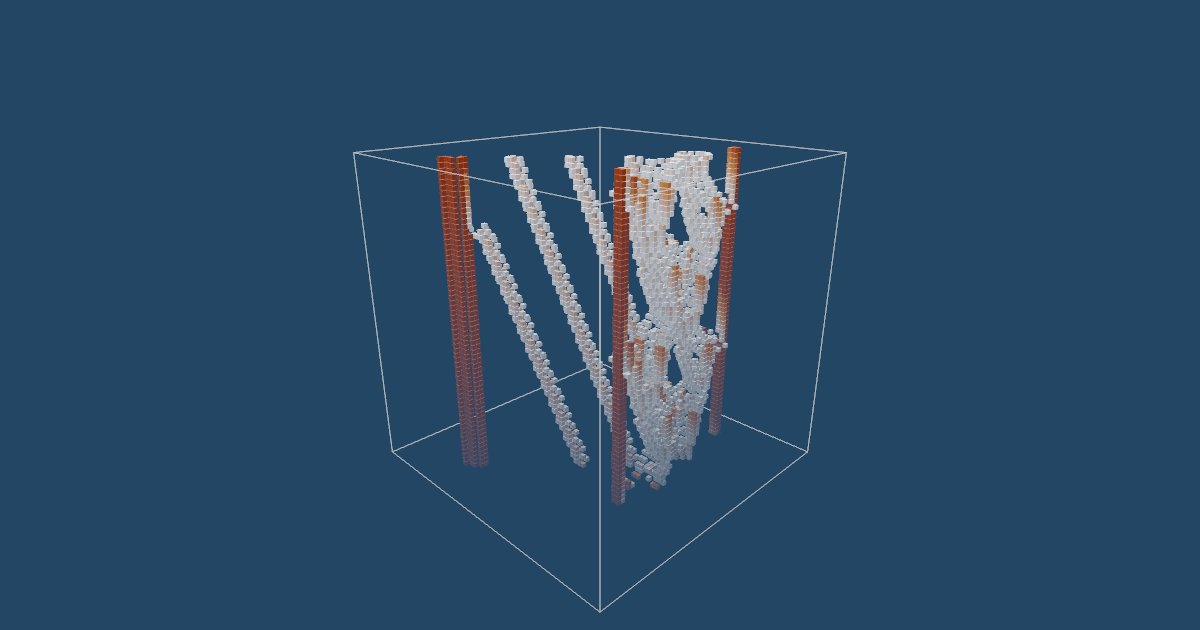
The stack keeps 8 to 128 generations, newest on top. X switches between the flat board and the stack, and each preset that moves comes with a camera angle across its path, since a glider's staircase seen along its path looks like a straight column.
The patterns
Fourteen presets, each with what to watch for:
| Preset | Rule | What to watch |
|---|---|---|
| Conway's Life | B3/S23 |
A random start settles into blocks, blinkers and gliders. |
| Glider | B3/S23 |
One cell diagonally every 4 generations: in the time stack, a staircase. |
| Lightweight spaceship | B3/S23 |
Two cells along every 4 generations, half the speed of light. |
| Copperhead | B3/S23 |
One cell every 10 generations; found only in 2016. |
| Gosper glider gun | B3/S23 |
A new glider every 30 generations, eaten at the far end. |
| Pentadecathlon | B3/S23 |
Repeats every 15 generations: a braided column in the stack. |
| Pulsar | B3/S23 |
Period 3, the commonest oscillator with a period above 2. |
| Diehard | B3/S23 |
Seven cells that vanish after exactly 130 generations. |
| R-pentomino | B3/S23 |
Five cells that take 1,103 generations to settle. |
| Acorn | B3/S23 |
Seven cells, 5,206 generations of growth. |
| HighLife replicator | B36/S23 |
Copies itself every 12 generations. |
| Day & Night | B3678/S34678 |
Live and dead play the same game, so islands of each grow and shrink. |
| Seeds | B2/S |
No cell survives, yet the world explodes. |
| Maze | B3/S12345 |
A small start grows a maze of corridors. |
The R-pentomino and the acorn settle only on an unbounded plane; on a board, their gliders reach the edge first. Every preset's claim is checked by the app's tests: the glider's period and step, Diehard's 130 generations, the replicator's two copies at generation 12.
Other rules
Conway's rule is one of many life-like rules: any choice of birth counts and survival counts from 0 to 8. In Advanced mode, type
one in B/S notation (B36/S23, or S23/B3, or 23/3), switch single counts on the
Born/Survives grid, or choose one of 20 rules with names: Life itself, HighLife, Day & Night, Seeds, Maze, Mazectric, Coral,
2×2, Move, Diamoeba, Anneal, Amoeba, Replicator, Life without death, Long Life, Stains, Walled Cities, Pedestrian Life,
DotLife and Gnarl, or press Surprise me for a named rule you are not on, from a new random start.
Patterns from files
Paste a pattern as RLE, the format of LifeWiki, Golly and most Life
programs (with its #N name and rule = line), or as plaintext .cells. The board grows to
fit, with 16 cells to spare around the pattern, up to 512×512. The other way, Copy the board as RLE puts it
on the clipboard for Golly or LifeViewer. A pattern can travel in a link too: ?dim=2&rle2= followed by the RLE.
Open in 3D
Any 2D board can be lifted into the 3D world. Open in 3D copies it onto two layers of a 3D box and switches to
Carter Bays' 3D rule Life 5766 (B6/S5-7). Two identical layers under that rule
play Conway's game exactly, until a cell is born outside them; from then on the pattern is truly three-dimensional.
From 2D to 3D explains why, and which patterns keep to their two layers.
What you can do in the app
- Boards from 32×32 to 512×512 cells, wrapping round at the edges or with dead edges.
- Painting. E, or Edit in the dock: click or drag on the board; starting on a live cell erases.
- The 3D app's controls. Run, Step, Back, Restart, the timeline and the charts work as in 3D, and the camera still orbits, so you can look at the board, or the stack, from any side.
- Sharing. Share this world sends the board as a link, a short link, an embed or a file, and it opens in 2D.
- Free. All of 2D mode is free, with no account.
Questions
Is the board infinite? No. Boards go up to 512×512 and either wrap or have dead edges, so long-lived patterns like the acorn meet an edge. For unbounded patterns, Golly's HashLife is the tool.
Does it work on a phone? Yes: drag to orbit, pinch to zoom, and paint with a finger once Edit is on.
Why is a 2D game in a 3D app? For the time stack and for Open in 3D, and because the 2D game is where the 3D and 4D ones start: From 2D to 3D, then the 4D Game of Life.
Further reading
- Martin Gardner, Mathematical Games: "The fantastic combinations of John Conway's new solitaire game 'life'", Scientific American 223 (October 1970), 120–123.
- LifeWiki, for everything about the 2D game.
- From 2D to 3D: why Conway's rule needs changing in 3D, and which 3D rules come closest.
- 4D Game of Life: the same question one dimension further.