Life 5766
Explorer rule · B6/S5-7
Bays' Life 5766: B6/S5-7, slow solid growth. The 2x2x2 block is a still life. (Earlier versions also listed it as Stable Growth.)
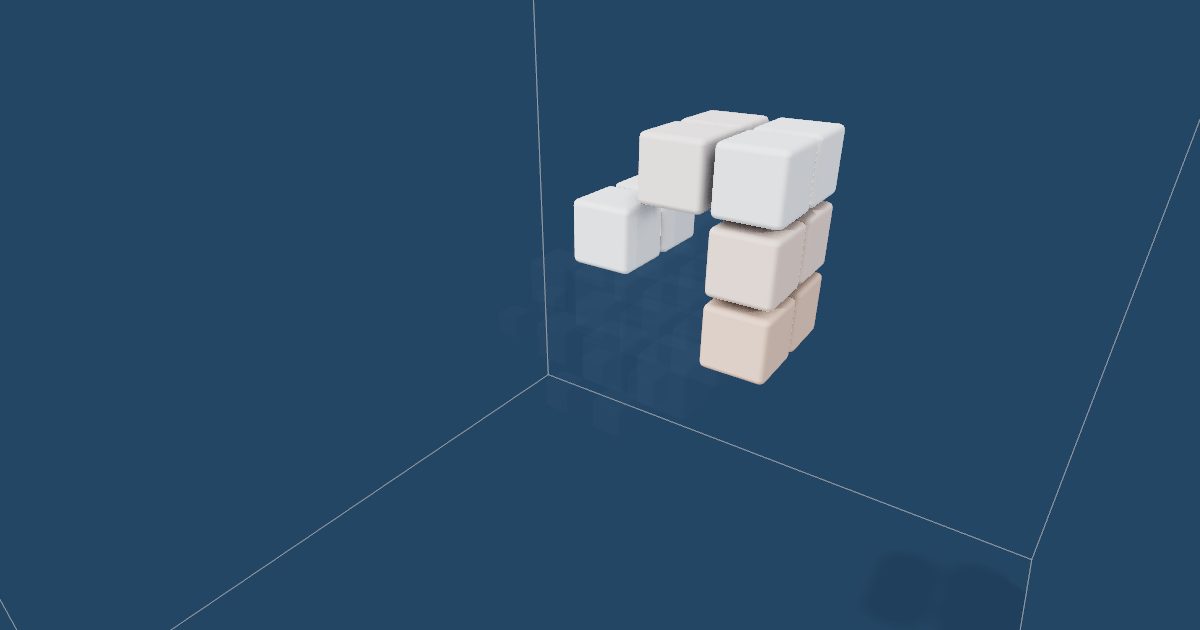
Bays' second rule
Life 5766 is the other rule Carter Bays proposed in Candidates for the Game of Life in Three Dimensions (Complex Systems 1, 1987, page 373): a live cell survives with
5 to 7 live neighbours and a dead cell is born with exactly 6, B6/S5-7. It settles faster than
Life 4555, and the 2×2×2 block is a still life: each of its cells has 7 live neighbours.
Conway's game inside it
Copy every cell of a 2D pattern onto the next layer, so the pattern is two identical layers thick. A live cell that had
n neighbours in 2D now has 2n + 1: its n neighbours twice, plus its twin. A dead cell has
2n. Born on 6 means exactly n = 3, and surviving on 5 or 7 means n = 2 or 3. That is Conway's
B3/S23, so the two layers play Conway's game exactly.
There is a catch. A cell in the layer beside the pair sees one copy of the pattern: the 2D count of the cell next to it, plus that cell. If a dead cell of the 2D pattern ever has 6 neighbours, or a live one has 5, that count reaches 6 and a cell is born outside the two layers; from then on the pattern is truly 3D. The glider, blinker, block, beehive and toad never do this. The lightweight spaceship and the R-pentomino break within two generations.
The two-layer glider, which Life 5766 opens on → Draw your own in 2D, then Open in 3D →
What random starts do
From 20 random fills (15% of cells alive) in a 30×30×30 box, all 20 had settled within 300 generations, half of them by generation 32: 16 into still lifes and 4 into oscillators of period 2. None died out, and what is left is sparse, at most 0.3% of the box.
How the rule works
- Each cell has 26 neighbours: every cell that shares a face, an edge or a corner with it (the Moore neighbourhood).
- An empty cell comes alive when exactly 6 of its neighbours are alive.
- A live cell stays alive when 5 to 7 of its neighbours are alive; otherwise it dies.
Picking it in the app restarts the world from the Glider (two layers) pattern.
Notation
| Birth/survival | B6/S5-7 |
|---|---|
| Softology, MCell (S/B/C/N) | 5-7/6/2/M |
| Weighted counting | B16/S15-17 (faces count 3, edges 2, corners 1) |
| Neighbourhood | Moore (26 cells) |
B lists the neighbour counts at which an empty cell is born, S those at which a live cell survives, and C the number of states. How to read a rule
More explorer rules
- 2D Conway
B3/S2-3 - Life 4555
B5/S4-5 - Spiky
B4-6/S5 - Seeds
B3/S - Maze
B3/S1-5 - Explosive
B4-5/S3-4 - Day & Night
B3,6-8/S3-4,6-8
All 30 rules · From 2D to 3D: why Conway's rule needs changing in 3D