2D Conway
Explorer rule · B3/S2-3
Conway's 2D rule with 26 neighbours: the flat 2D glider it starts from bursts out of its plane.
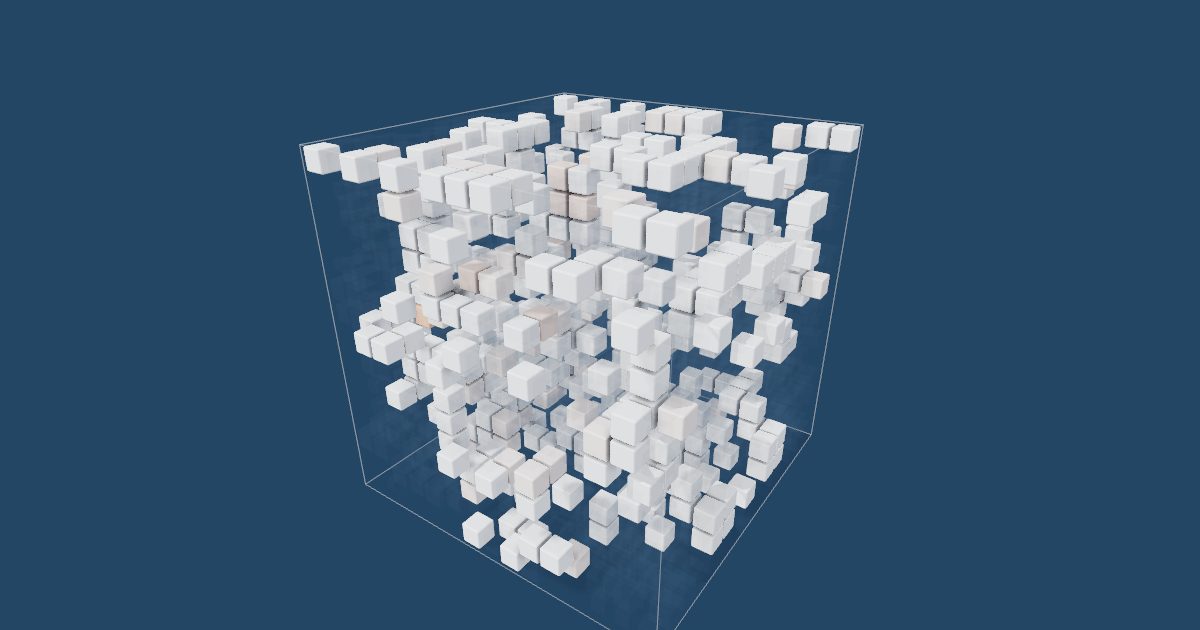
Conway's rule with 26 neighbours
Conway's rule was made for a flat grid, where a cell has 8 neighbours. Put a glider on one layer of a 3D world and it does the right thing in its own layer for a generation. But the dead cell directly above a live cell counts the 3×3 patch beneath it, and wherever that patch holds 3 live cells, a cell is born. The glider leaks into the layers above and below, and they leak further: in a 15×15×15 box, its 5 cells are 489 after 12 generations.
Where Conway's game does work
With 26 neighbours a count of 3 is too easy to reach, so 3D rules need bigger numbers. Carter Bays found that under Life 5766 a 2D pattern copied onto two layers plays Conway's game exactly. For the game itself, the app has a 2D mode on a flat board, with a time stack that piles up the generations in 3D, and From 2D to 3D goes through the whole story.
How the rule works
- Each cell has 26 neighbours: every cell that shares a face, an edge or a corner with it (the Moore neighbourhood).
- An empty cell comes alive when exactly 3 of its neighbours are alive.
- A live cell stays alive when 2 or 3 of its neighbours are alive; otherwise it dies.
Picking it in the app restarts the world from the Glider (2D seed) pattern.
Notation
| Birth/survival | B3/S2-3 |
|---|---|
| Softology, MCell (S/B/C/N) | 2-3/3/2/M |
| Weighted counting | B9/S6-9 (faces count 3, edges 2, corners 1) |
| Neighbourhood | Moore (26 cells) |
B lists the neighbour counts at which an empty cell is born, S those at which a live cell survives, and C the number of states. How to read a rule
More explorer rules
- Life 4555
B5/S4-5 - Spiky
B4-6/S5 - Seeds
B3/S - Maze
B3/S1-5 - Explosive
B4-5/S3-4 - Day & Night
B3,6-8/S3-4,6-8 - Life 5766
B6/S5-7
All 30 rules · From 2D to 3D: why Conway's rule needs changing in 3D