Life 4555
Explorer rule · B5/S4-5
Supports gliders and stable structures.
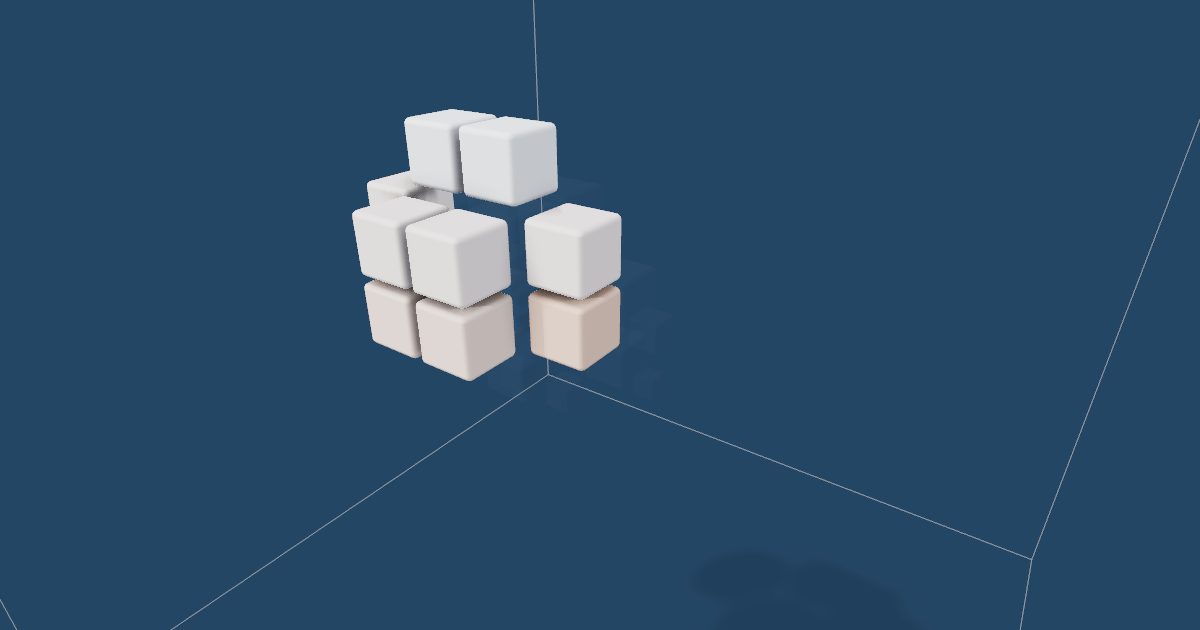
Bays' rule
In 1987 Carter Bays published Candidates for the Game of Life in Three Dimensions in Complex Systems (volume 1, page 373). He looked for 3D rules worthy of the name Game of Life: random starts that settle down instead of growing without limit, and a glider that turns up on its own from them. Of the rules with a range of birth counts and a range of survival counts, two passed: Life 4555 and Life 5766.
Bays writes a rule as four numbers: the fewest and most live neighbours with which a live cell survives, then the fewest and most
with which a dead cell is born. Conway's rule is 2333. Life 4555 survives on 4 or 5 and is born on 5, written B5/S4-5
here: Conway's numbers, each raised by 2.
The glider
Life 4555 has a glider of its own, found early in Bays' search and the reason he studied the rule closely. It has 10 cells and a period of 4: every 4 generations it is back in its first shape, one cell further along two axes at once, and it can travel in any of 12 such diagonal directions. It is rare from random starts: in the ten random-soup runs Bays tallied, a glider turned up once, so the app opens Life 4555 on the glider itself.
What random starts do
From 20 random fills (15% of cells alive) in a 30×30×30 box, every run had ended within 300 generations, half of them by generation 81: 11 froze into still lifes, 6 settled into oscillators with period 2 or 4, and 3 died out. What is left is sparse, never more than 0.2% of the box. That is Bays' first test passed: random starts stay bounded.
How the rule works
- Each cell has 26 neighbours: every cell that shares a face, an edge or a corner with it (the Moore neighbourhood).
- An empty cell comes alive when exactly 5 of its neighbours are alive.
- A live cell stays alive when 4 or 5 of its neighbours are alive; otherwise it dies.
Picking it in the app restarts the world from the Glider 4555 pattern.
Notation
| Birth/survival | B5/S4-5 |
|---|---|
| Softology, MCell (S/B/C/N) | 4-5/5/2/M |
| Weighted counting | B15/S12-15 (faces count 3, edges 2, corners 1) |
| Neighbourhood | Moore (26 cells) |
B lists the neighbour counts at which an empty cell is born, S those at which a live cell survives, and C the number of states. How to read a rule
More explorer rules
- 2D Conway
B3/S2-3 - Spiky
B4-6/S5 - Seeds
B3/S - Maze
B3/S1-5 - Explosive
B4-5/S3-4 - Day & Night
B3,6-8/S3-4,6-8 - Life 5766
B6/S5-7
All 30 rules · From 2D to 3D: why Conway's rule needs changing in 3D