Standard
Classic rule · B4-5/S4-6
The default: the sphere breaks open and the box fills with churning structure that never settles.
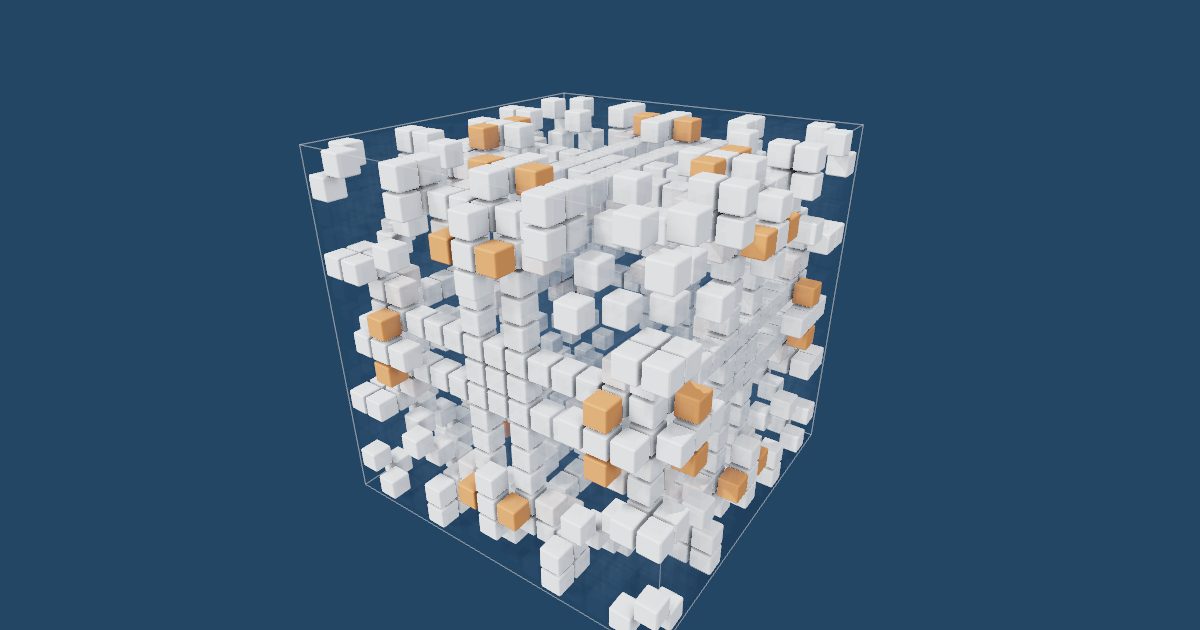
The rule the app opens on
The 3D Game of Life starts on this rule, with a sphere of 123 cells in a 15×15×15 box. It is the rule the project's first version shipped with. It is not one of the two rules Carter Bays proposed in 1987 (Life 4555 and Life 5766): it gives birth more easily, so a world grows and keeps moving, which makes a livelier first view.
What it does
The sphere breaks open and the box fills with churning structure that does not settle. In the 15×15×15 box it is still changing after 300 generations, with about 28% of the cells alive. From 20 random fills (15% of cells alive) in a 30×30×30 box, not one run settled or died out within 300 generations; each was still churning at about a quarter full.
That is the difference from Bays' rules. His first test of a 3D Game of Life is that random starts settle down instead of running on forever, and this rule does not pass it. It makes a world to watch rather than one that freezes.
How the rule works
- Each cell has 26 neighbours: every cell that shares a face, an edge or a corner with it (the Moore neighbourhood).
- An empty cell comes alive when 4 or 5 of its neighbours are alive.
- A live cell stays alive when 4 to 6 of its neighbours are alive; otherwise it dies.
Picking it in the app restarts the world from the Sphere pattern.
Notation
| Birth/survival | B4-5/S4-6 |
|---|---|
| Softology, MCell (S/B/C/N) | 4-6/4-5/2/M |
| Weighted counting | B12,15/S12,15,18 (faces count 3, edges 2, corners 1) |
| Neighbourhood | Moore (26 cells) |
B lists the neighbour counts at which an empty cell is born, S those at which a live cell survives, and C the number of states. How to read a rule
More classic rules
- Stable
B4/S4-5 - Chaotic
B3-6/S2-5 - Die-Off
B5-6/S5-6 - Explosive
B2-6/S1-6 - Crystal
B5/S3-5 - Pulsating
B4-6/S3-4 - Maze
B3-4/S3-4 - Sparse
B6/S5
All 30 rules · From 2D to 3D: why Conway's rule needs changing in 3D