Clouds 1
From Softology's collection · B13-14,17-19/S13-26
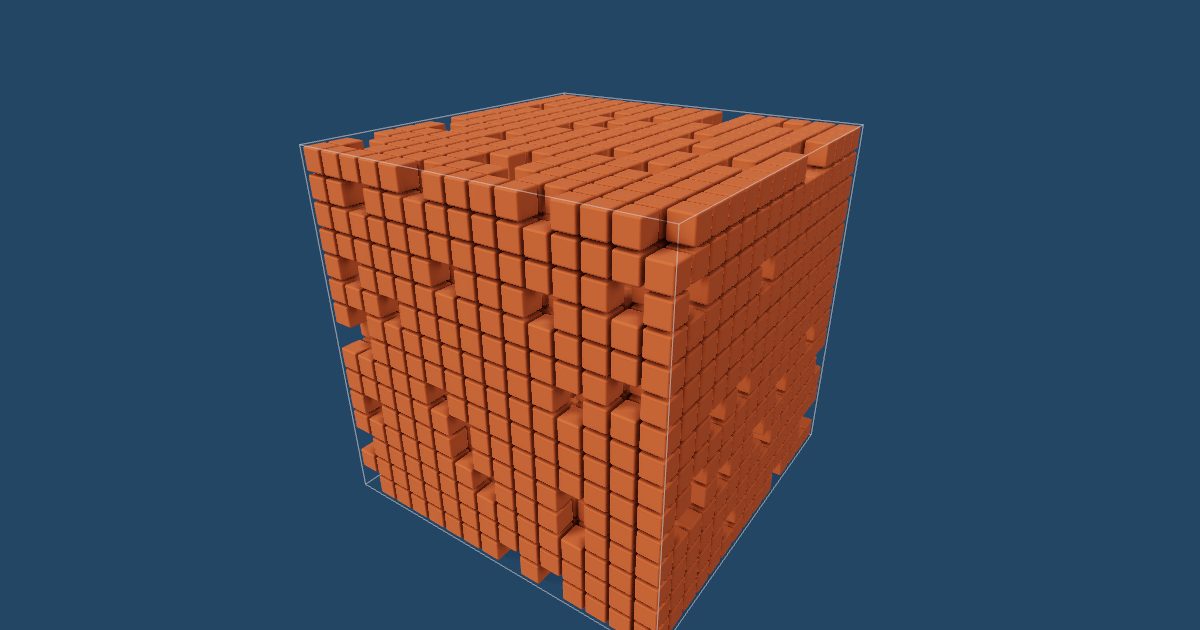
A dense random fill clumps into smooth clouds within a few generations, then holds still.
The rule
In Softology's notation 13-26/13-14,17-19/2/M: a live cell survives with 13 or more live neighbours, half of its 26
or more, and a dead cell is born with 13, 14, 17, 18 or 19. Two states, so a cell is simply alive or dead. A cell needs a crowd
around it either way, so lone cells and thin strands vanish and noise smooths into rounded masses.
What it does
It starts from a random fill with 60% of the cells alive. In 20 seeded runs in a 30×30×30 box, every one had stopped changing between generations 7 and 12, with about 89% of the box alive: from outside, a block. The cutaway (C) and the slice view (S) show the shapes inside it.
Clouds 2 has fewer births (13 or 14) and survives from 12: in the same test its clouds were thinner, about 70% of the box.
How the rule works
- Each cell has 26 neighbours: every cell that shares a face, an edge or a corner with it (the Moore neighbourhood).
- An empty cell comes alive when 13, 14 or 17 to 19 of its neighbours are alive.
- A live cell stays alive when 13 to 26 of its neighbours are alive; otherwise it dies.
Picking it in the app restarts the world from a random fill with 60% of cells alive. Its seed is fixed, so it is the same world every time, one still alive 40 generations later in the default 15×15×15 box; N tries another seed.
Notation
| Birth/survival | B13-14,17-19/S13-26 |
|---|---|
| Softology, MCell (S/B/C/N) | 13-26/13-14,17-19/2/M |
| Neighbourhood | Moore (26 cells) |
B lists the neighbour counts at which an empty cell is born, S those at which a live cell survives, and C the number of states. How to read a rule
More of Softology's rules
- 445
B4/S4/C5 - Amoeba
B5-7,12-13,15/S9-26/C5 - Architecture
B3/S4-6 - Builder 1
B4,6,8-9/S2,6,9/C10 - Builder 2
B1/S5-7 - Clouds 2
B13-14/S12-26 - Coral
B6-7,9,12/S5-8/C4 - Crystal Growth 1
B1,3/S0-6 - Crystal Growth 2
B1,3/S1-2/C5 - Pyroclastic
B6-8/S4-7/C10 - Spiky Growth
B13,17,20-26/S0-3,7-9,11-13,18,21-22,24,26/C4 - 3D Brain
B4/S
All 30 rules · From 2D to 3D: why Conway's rule needs changing in 3D